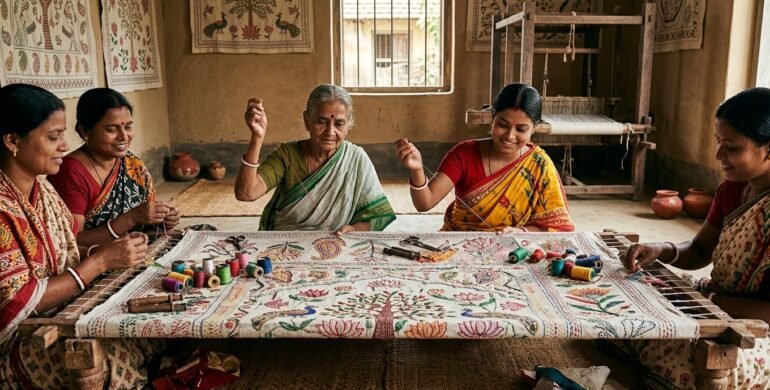
Rukminibai did not learn her craft in a classroom.
She learned it sitting beside her grandmother, watching closely, repeating slowly, until her hands began to understand what words could not explain. The loom was not introduced to her – it was always there. So were the patterns.
They belonged to her community.
Carried across generations.
Refined by women who understood thread, tension, and colour the way a musician understands rhythm – instinctively, precisely, without needing to explain it.
To Rukminibai, it was ordinary.
Her mother called it ordinary.
Her village called it ordinary.
It was simply what they did – something made, used, and passed on. Not something that travelled. Not something that was seen as rare. Nothing about her skill needed to change.
What changed was how it was seen.
Her patterns were documented – not just as designs, but as a language tied to place and memory.
Her work was photographed with care, capturing the intricacy that often goes unnoticed.
Her story was written – a simple provenance, placing her craft where it belonged: not as product, but as heritage.
Her first collection moved beyond her village, introduced to a curated network of buyers in Bengaluru.
The second found its way to a platform in Mumbai.
And then, something shifted.
An inquiry arrived – from an ethical fashion buyer in the Netherlands.
For the first time, the work that had always stayed within the boundaries of her community had travelled across them – without losing its identity.
What was once considered ordinary now carries its true weight –
as something rare, deliberate, and deeply rooted.
And Rukminibai knows it.