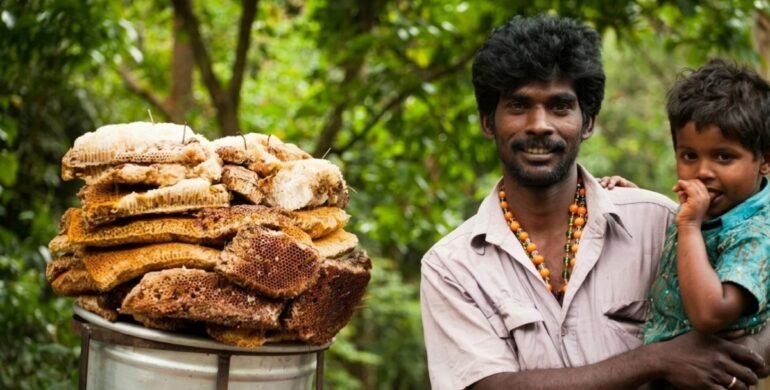
For Lokesh, the forest was a quiet provider, but a harsh negotiator.
He lived in a remote hamlet where the canopy of the Western Ghats met the sky. For generations, his family had gathered wild honey, amla, and medicinal roots. To Lokesh, this wasn’t a business; it was a way of life. He followed the trails his grandfather had carved, climbing high into the trees or trekking deep into the brush to collect what the season offered.
And yet, despite the richness of the forest, his pockets remained empty.
The Cycle of Dependency
Lokesh’s life was dictated by the “emergency sale.” Because he had no way to store the wild amla before it shrivelled, or filter the honey before it crystallized, he was forced to sell to the first trader who arrived with a truck.
- The Price: He was paid a fraction of the market value, often traded for basic rations or small amounts of cash that disappeared within a week.
- The Risk: He took all the physical risks- the steep climbs and the long treks- while the middlemen took all the profit.
- The Hesitation: Lokesh had heard of “Forest Committees” and government registrations, but they felt like shadows. He didn’t have the papers, the bank account, or the confidence to navigate a world that seemed to speak a different language.
For years, he stayed in the shadows of the trees. He was a gatherer, working day to day, never daring to think of the forest as a source of long-term wealth.
The Veeravratham Intervention
When the Veeravratham Foundation reached his hamlet, they didn’t bring a new way of life; they brought a new way of looking at his old one.
The foundation didn’t ask Lokesh to stop gathering; they showed him how to own the harvest. The shift was immediate and practical:
- Primary Processing: They provided the community with basic toolkits- honey filtration units and solar dryers. Lokesh learned that clean, filtered honey could be stored and sold when prices were high, rather than when he was desperate.
- The Power of the Collective: Lokesh was encouraged to form a small Tribal Producer Group with ten other men. Together, they stopped being individual sellers and became a supply chain.
- The Paperwork Bridge: The foundation walked him through the process of opening a bank account and obtaining the necessary tribal forest-produce permits. The “system” that once felt designed to exclude him was suddenly broken down into simple, manageable steps.
The Transformation
Within two seasons, Lokesh had moved from being an invisible laborer to a recognized supplier.